Being productive during the summer has always been a struggle for me. It's warm out, I'm at home, there appears to be endless hours and days and one can always do something other then what needs to be done. Yet, I have planned out some projects, am taking some classes and have a life to live.
First, I am taking eight hours of classes, (regional geography and microeconomics) and working on my senior paper. All them have one due date, the day I get back to school in late August.
Second, I am reading The Summa of the Summa. This repetitive title designates the great work written by Thomas Aquinas, Summa Theologica or Summary of Theology. Thank goodness I am reading only a summary of that summary. That means I'm only reading one volume instead of a couple dozen.
Third, I have my own reading projects of about 25 books categorized as following: history, philosophy, devotional literature, novels and education. (Reviews of some will be following.)
Fourth, I am training for three triathlons: The first is in June, second in August and the last in September. See previous post for racing goals.
Lastly, but not least, I am working as a pastoral intern at 2nd Reformed Presbyterian Church, my church. I'm helping out with the high school group, helping lead a missions trip, being a counselor at Covfamikoi and doing what Pastor Johnston needs me to do.
Now, am I going to be able to accomplish all my goals this summer, probably not, but I know that by setting up goals, it gives me more motivation to get things done that otherwise I would have not even had tried. It is better to set your mind to something, fail and reap the benefits of trying then to not ever try in the first place.
Thursday, May 27, 2010

Friday, May 7, 2010
Chaz Bono, how does the Church Respond
Chaz Bono recently has completed a sex change. Now he is recognized by the United States government as a man. Known previously as Chasity, Chaz's parents are singers, apparently famous but I don't know who they are. (then again, I don't follow contemporary music very much.)
How does the church respond to someone who changes their gender? The cornerstone of the church is Christ, a man and God who befriended and publicly associated with prostitutes, tax collectors and gentles. (Otherwise known as the "unpopular" or rejected group of people.) It is safe to say that Jesus would never had rejected someone who had a sex change.
Rebellion and the Church
One who is in rebellion against God is not in personal relation with God. They do not have salvation. [That is not to say that if one rejects God, God similarly responds.] The church can legitimately put someone who shows evidences of rebellion against God under church discipline. Is getting a sex change a sign of rebellion against God?
Why Get a Sex Change?
There are many reasons for getting a sex change:
1. Don't feel comfortable with your gender.
2. Physiologically you are caught in the opposite gender of who you really are.
-This reason assumes many things about sexuality, identity, views of of the soul.
3. You want to be different.
There could be many others, and it is probably much more complicated then the reasons I have given. Bottom line: if one has a sex change out of rebellion against God then it gives warrant for the church to put that individual under church discipline. [note: if I started to drink alcohol out of rebellion against God this gives the church warrant to put me under church discipline. Having a sex change does not automatically qualify as a sin, just like drinking alcohol. ]
What is Church Discipline
I do not mean shunning an individual or kicking them out of the church when I use the term "church discipline." I mean it in a larger context: from an elder or pastor coming alongside someone and exhorting them on their behavior to a friend confronting his brother/sister in Christ.
There is formal church discipline informal church discipline. Formal discipline is the church acting as an official body responding to someone's actions and privately/publicly disciplining them. Informal discipline would be an elder or pastor coming alongside someone and exhorting them on their behavior.
So how does the Church Respond
Certain things will not change if a person has a sex change even if they are or are not a member of the church.
1. The Church does not condemn
2. The Church comes alongside and loves as Christ loves.
3. The church protects itself from intruders, people not of the faith.
4. The Church helps its members by exhorting one another.
So what does the church do?
I don't have an answer to this question. I think that it there needs to be carefully thought through Here are my thoughts: 1. You don't want to reject someone who has become repentant of their sin. 2. You don't want to allow a unrepentant (person in rebellion) person to be a part of your community. 3. The church needs to be careful not to condemn people who undergo sex changes. What do I mean by this? I mean, the church needs to treat these people as who they are, human beings. They have gone through a unique and rare process, that doesn't disqualify them from being the same beings as you and me.
Bottom Line
In the situation where a person who undergoes a sex change wants to become a part of the church, the churches response should be one of love and shouldn't treat that individual any differently then anyone else.
How does the church respond to someone who changes their gender? The cornerstone of the church is Christ, a man and God who befriended and publicly associated with prostitutes, tax collectors and gentles. (Otherwise known as the "unpopular" or rejected group of people.) It is safe to say that Jesus would never had rejected someone who had a sex change.
Rebellion and the Church
One who is in rebellion against God is not in personal relation with God. They do not have salvation. [That is not to say that if one rejects God, God similarly responds.] The church can legitimately put someone who shows evidences of rebellion against God under church discipline. Is getting a sex change a sign of rebellion against God?
Why Get a Sex Change?
There are many reasons for getting a sex change:
1. Don't feel comfortable with your gender.
2. Physiologically you are caught in the opposite gender of who you really are.
-This reason assumes many things about sexuality, identity, views of of the soul.
3. You want to be different.
There could be many others, and it is probably much more complicated then the reasons I have given. Bottom line: if one has a sex change out of rebellion against God then it gives warrant for the church to put that individual under church discipline. [note: if I started to drink alcohol out of rebellion against God this gives the church warrant to put me under church discipline. Having a sex change does not automatically qualify as a sin, just like drinking alcohol. ]
What is Church Discipline
I do not mean shunning an individual or kicking them out of the church when I use the term "church discipline." I mean it in a larger context: from an elder or pastor coming alongside someone and exhorting them on their behavior to a friend confronting his brother/sister in Christ.
There is formal church discipline informal church discipline. Formal discipline is the church acting as an official body responding to someone's actions and privately/publicly disciplining them. Informal discipline would be an elder or pastor coming alongside someone and exhorting them on their behavior.
So how does the Church Respond
Certain things will not change if a person has a sex change even if they are or are not a member of the church.
1. The Church does not condemn
2. The Church comes alongside and loves as Christ loves.
3. The church protects itself from intruders, people not of the faith.
4. The Church helps its members by exhorting one another.
So what does the church do?
I don't have an answer to this question. I think that it there needs to be carefully thought through Here are my thoughts: 1. You don't want to reject someone who has become repentant of their sin. 2. You don't want to allow a unrepentant (person in rebellion) person to be a part of your community. 3. The church needs to be careful not to condemn people who undergo sex changes. What do I mean by this? I mean, the church needs to treat these people as who they are, human beings. They have gone through a unique and rare process, that doesn't disqualify them from being the same beings as you and me.
Bottom Line
In the situation where a person who undergoes a sex change wants to become a part of the church, the churches response should be one of love and shouldn't treat that individual any differently then anyone else.
Wednesday, April 28, 2010
The Pathway Between the Seas - a review
 David McCullough wrote Pathway Between the Seas (PBS) which is about the building of the Panama Canal, one of the greatest building achievements in world history.
I just finished this book on Sunday but had started in February. It is a very long book, around 600 pages, but I enjoyed it. McCullough does a great job of funneling many details and descriptions into many different themes, based on a single thread.
Why it is a such a good book
I most enjoyed the characters in PBS. McCullough does a great job of tying in many different biographies and placing them in the context of the building process. One of my favorite parts was the U.S. political battle as to where the canal was going to be built and how Panama became an independent nation.
How a 600 page book can be a quick read
PBS is a very long book filled with a lot of detailed information and it is easy to get lost in all of it. I'm not sure if this is a weakness of the book. McCullough does a great job of controlling the amount of information given to the reader, but the nature of the topic causes it to lean toward too much information. I found it best to pay attention to the main characters and do my best to remember their names. (Even if they weren't easy to remember.) Also, I tried to hold onto the main theme of each chapter, which was not too hard to do because the writer is a master at creating narratives.
Who should Read it
If you enjoy history and are comfortable weeding through a lot of details while holding on to a main theme, I would suggest that this would be a good summer read. The length of the book is challenging, but it is definitely worth reading.
What I learned
One general idea I gleaned from this book was that large movements are often controlled and determined by individual leaders. The failure of the French was caused by the naivete and ignorance of the French leaders. The success of the Americans was caused by the tenacity, organization skill and discipline of individual leaders. It surprised me that even such a large project as the Panama Canal (Its scale is massive, absolutely incredible. The locks that were built are so big that they would be part of the sky line in New York City. Only the Empire State Building and a couple other skyscrapers would be larger.) would be greatly determined by individuals. It helped me realize why one's individual actions can have momentous consequences for other people around us.
Monday, April 26, 2010
Why are Taylor Men Passive?
The other day I stated on my facebook a question, "Why are Taylor men passive?" Two people who were not from Taylor commented. (My lovely sister Sarah Pulliam Bailey and not so lovely looking Eddie Burris) Thank you to both of them for commenting and I hope they continue to dialogue with each other on this issue.
The reason I asked this question was because Taylor men are quite passive. The most recent evidence is regarding the number of males who applied for Lighthouse trips next year. For those of you not familiar with Taylor or Lighthouse, Lighthouse is a campus organization that sends out students on short-term mission trips for J-term every year. Approximately 25% of the applicants were males.
Men are a minority on campups so there should be less male applicants then female applicants simply because there are less men on campus but why is it so low?
Eddie Burris blames the feminist movement, Sarah disagrees. I'll let them debate that point.
I think that there are deeper reasons for this serious problem. I strongly believe that it comes down to two issues: gender relations and identity.
First, gender relations.
Men on campus don't see themselves as authorities or examples to women. Some think this is linked with how women see themselves and men, but ultimately, it comes down to how men see their relation with people. Guys don't want to be leaders and those who are leaders are often hurt by people's rejection of their authority. If you want to insult a guy, don't listen to him, acknowledge what he says or respect one of his requests. This doesn't obeying a every guys wish, but boy it is extremely insulting when you ignore a guy who is in a leadership position. (This is not to say that this excuses men. God calls men act like Christ [and women]. Christ took insult all the time, but did not quit or become passive. Men have no excuse!)
Second, identity.
A man's identity is a really big deal, a really, really, really big deal. If a man loses his identity (generally) or does not have one, he will more likely be passive and counter-productive. Furthermore, if he doesn't have a strong identity or a stable identity the same result will occur, passivity. (Generally speaking of course.) Especially with young men, there needs to be a battle for us to fight, and it has to be one which we think we can win! (So don't suggest to a guy that he defeat world poverty.) Fighting a battle can be a major part of a guy's identity. I do not mean by "a battle" literally fighting or picking up a big cause. I mean holding to something that is seen as important and worth sacrificing for. More importantly, most of the time, a male's identity is more then likely trapped in an addiction. Specifically, a lot of men are addicted to pornography and sexual sin. There are more and more studies coming out on the addictive nature of pornography. There are other substances that are addictive in nature to men, but I want to specifically point out pornography because it is becoming more of an issue for the church.
Conclusion
So that is what I think about that. I would be especially interested in hearing people's comments and observation about this problem. By the way, I can't go on lighthouse because I have school.
passing note: people often point out video games are the problem, I think that they are a consequence of the problem, not the problem itself.
The reason I asked this question was because Taylor men are quite passive. The most recent evidence is regarding the number of males who applied for Lighthouse trips next year. For those of you not familiar with Taylor or Lighthouse, Lighthouse is a campus organization that sends out students on short-term mission trips for J-term every year. Approximately 25% of the applicants were males.
Men are a minority on campups so there should be less male applicants then female applicants simply because there are less men on campus but why is it so low?
Eddie Burris blames the feminist movement, Sarah disagrees. I'll let them debate that point.
I think that there are deeper reasons for this serious problem. I strongly believe that it comes down to two issues: gender relations and identity.
First, gender relations.
Men on campus don't see themselves as authorities or examples to women. Some think this is linked with how women see themselves and men, but ultimately, it comes down to how men see their relation with people. Guys don't want to be leaders and those who are leaders are often hurt by people's rejection of their authority. If you want to insult a guy, don't listen to him, acknowledge what he says or respect one of his requests. This doesn't obeying a every guys wish, but boy it is extremely insulting when you ignore a guy who is in a leadership position. (This is not to say that this excuses men. God calls men act like Christ [and women]. Christ took insult all the time, but did not quit or become passive. Men have no excuse!)
Second, identity.
A man's identity is a really big deal, a really, really, really big deal. If a man loses his identity (generally) or does not have one, he will more likely be passive and counter-productive. Furthermore, if he doesn't have a strong identity or a stable identity the same result will occur, passivity. (Generally speaking of course.) Especially with young men, there needs to be a battle for us to fight, and it has to be one which we think we can win! (So don't suggest to a guy that he defeat world poverty.) Fighting a battle can be a major part of a guy's identity. I do not mean by "a battle" literally fighting or picking up a big cause. I mean holding to something that is seen as important and worth sacrificing for. More importantly, most of the time, a male's identity is more then likely trapped in an addiction. Specifically, a lot of men are addicted to pornography and sexual sin. There are more and more studies coming out on the addictive nature of pornography. There are other substances that are addictive in nature to men, but I want to specifically point out pornography because it is becoming more of an issue for the church.
Conclusion
So that is what I think about that. I would be especially interested in hearing people's comments and observation about this problem. By the way, I can't go on lighthouse because I have school.
passing note: people often point out video games are the problem, I think that they are a consequence of the problem, not the problem itself.
Wednesday, April 14, 2010
Antony Flew, 1923-2010
One of the major philosophers of the 20th century has died. Antony Flew was an English philosopher who defended atheism until 2004 when he publicly claimed to be a theist. Sadly, he was minimalist and as far as we know, never acknowledged anything more then an Aristotelian God.
It should be pointed out that Flew did much more work then just atheism in philosophy. He was a leading scholar on David Hume, major critic of John Rawls in political philosophy and did work in philosophy of education. This is only some of what he did work in.
It should be pointed out that Flew did much more work then just atheism in philosophy. He was a leading scholar on David Hume, major critic of John Rawls in political philosophy and did work in philosophy of education. This is only some of what he did work in.
Monday, April 5, 2010
Responses to Criticism against berkeleyan/Edwardsian Idealism
In my last post I gave my argument for why I am an Idealist. Specifically, to be is to be perceived. The ontological status of the physical world is based upon one's perception of it. In my last post, I answered an objection regarding relativity of idealism, whether physical reality is simply relative to one's perception.
The Problem of Pantheism
The first problem that I want to work with is the problem of pantheism. On facebook, Ryan Mullins brought this problem up:
Problem of relations of minds
This is a serious problem for the idealist. It goes like this:
3. the boxed God problem
This is a very serious problem for the idealist. It took me a long time to work through this problem:
Halftime is over, Go Butler!!!!!
The Problem of Pantheism
The first problem that I want to work with is the problem of pantheism. On facebook, Ryan Mullins brought this problem up:
The physical world is made up of God's thoughts. God's thoughts and actions are equivocal. God's actions are a part of his being. So, the physical world is a part of God's being.The problem is that neither Berekeley nor Edwards would want to be pantheists. Neither do I. There are a couple of responses an idealist can give. First, is God a simple substance? Second, just because God thinks something, that does not mean it is an thought of God in this particular world. (Abraham inquiring God to consider a change in his plan.) I think God is powerful enough to be able to think of something while not it being revealed to us.
Problem of relations of minds
This is a serious problem for the idealist. It goes like this:
We are God's thoughts, we are ideas of God, our mind's are, but our minds also create ideas and perceive God's ideas. What is the relation between God's mind and our's?This problem is very serious because the existence of our minds is based upon God's thoughts. I don't know the answer to this question. It's a major problem, but I don't see how it gives reason to say that idealism is false.
3. the boxed God problem
This is a very serious problem for the idealist. It took me a long time to work through this problem:
The idealist is coming to his position based off of problem for the naive and representational realists. God, how the idealist believes he exists, his ontology, is based off other understanding of the world. His beliefs about God do not stem from who God reveals himself, rather they result from responding to how he understands.I will expand on this in my next post. Note: There is a lot here that needs to be developed. Sorry the Butler game is more important!
Halftime is over, Go Butler!!!!!
Thursday, March 25, 2010
Why I am a Berkelian/Edwardsian Idealist
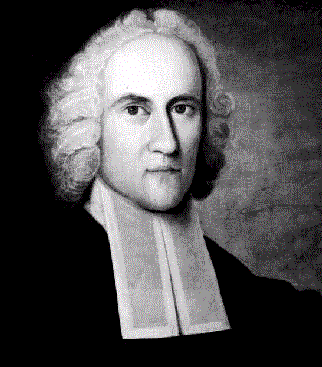
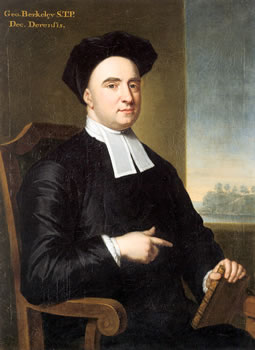 During my spring semester, freshmen year, I was sitting in my history of philosophy II course, listening to Dr. Jim Spiegel discuss John Locke's theory of perception: We experience the world in terms of primary qualities and secondary qualities. Primary qualities would include bulk, figure, texture, and motion. Secondary qualities would include colors, smells, tastes etc. All qualities are experienced by humans who derive ideas from them, simple and complex ideas.
A question about how humans experience the world should naturally come up about the world itself. There needs to be something underlying these qualities, upholding them. Locke called this underlying thing a "material substratum." It is non-experiential and non-observable. Locke postulates that it exists because there needs to be something underlying all these qualities. They can't just sit out there without anything upholding them. How else can they have regularity and unity?
Locke's Doctrine was heavily critiqued by a bishop, an Irish bishop, named George Berkeley. (note: Berkeley was a man of the church, Locke was not and in fact was unorthodox. Theologians should take special not of that point! Irish people should take note that Berkeley is Irish.) Berkeley attacks Locke (And representationalist realism) on two key points. First, why do we need to postulate that there is a material substratum? Locke's make-up of the world (ontology) includes: minds, ideas and substratum. Berkeley argued that there is no need for a mysterious material substratum because its purpose is fulfilled by God. He upholds the universe by his thoughts. Unity and continuity in the physical world can be explained by saying that they are God's thoughts and their existence stems from him as ideas. Second, Berkeley attacked Locke by saying that you don't even know anything about this material substratum. If everything is known by experience, how do you know this thing exists? You can't in Locke's system.
So, according to Berkeley, the reality is made up of minds and ideas. There are two types of minds, finite and infinite minds. There are two types of ideas: real ideas and imaginary ideas. Humans are finite minds. God is an infinite mind. A real idea would be an idea that is contained in the mind of God and an imaginary idea would be an idea that we make up in our heads (imagine sci-fi horrifying monster.) Real ideas are public, imaginary ideas are private. A real idea would be the black phone right next to my computer screen. These ideas stem from God.
That's not too bad, esoteric and irrelevant to our regular lives, but wait. The repercussions of this is "esse est percipi," (To be, is to be perceived.). What? In order to exist, you must be perceived. That's odd. That means if a tree fell in the woods and no one perceived it hitting the ground, there would be no sound of it falling and in fact, there would be no tree. The reason, though, that we find trees laying on the ground with the appearance that they have fallen from their standing position is not just because you or some other finite mind perceived them. Rather it is because God perceived them, as an infinite mind, they did fall and with a noise.
In order for ideas to exist they must be contained in a mind. Ideas are mind-dependent. The physical world is made up of ideas and so the physical world is mind-dependent. It may appear that an idealist is a relativist (claiming their are no absolute truths) because all ideas are mind-dependent. That's not true. (Get it? hehe) For one, the idealist is making a universal claim about reality in actuality. For another, the only thing that is different for the idealist as opposed to the representative realist, is that the world is made up of all ideas. It does not say that all ideas are relative to the observer. It says the world is made up of ideas and is mind-dependent. My experience of reading this experience is similar to yours. The reason being, we are observing the same ideas which are God's ideas. (the black color against the white screen, the squiggly lines, the meaning derived.)
In my next post I will offer some more detailed objections to Bereklian idealism.
Subscribe to:
Posts (Atom)