Showing posts with label Book Review. Show all posts

Saturday, January 21, 2012

"Jesus Christ and the Life of the Mind" - a Review


Mark Noll has come out in his latest book, "Jesus Christ and the Life of the Mind" with a more optimistic picture of evangelical scholarship. He suggests a theological approach to guide evangelical scholarship in the future and provides three examples: history, science and Biblical studies.

The point of the Book 
Noll is attempting to outline a way evangelicals can do scholarship. His thesis is that evangelicals can do scholarship by using the Bible as its foundation, and the creeds are guides or ways of interpreting scripture. Specifically, we ought to use Jesus Christ as our lens in scholarship.

My Thoughts 
Noll presents an interesting thesis. I agree, and I hope all Christians do, with his general point, that Jesus Christ ought to frame our scholarship. I found the chapter on history to be good and helpful. Every Christian historian should read that chapter. The two chapters on science and Biblical studies I leave for others to discuss.

I am coming away from the book wondering whether Noll is saying something new or not. The basic idea of using Jesus in one's methodology isn't new. It is really a "well duh" point, or at least it should be. That's not to say Noll isn't make an interesting point. He gets interesting when he goes into detail on how the Apostles Creed, Nicene Creed and Chalcedon Creed are definitive statements for the Christian tradition. Noll pushes hard for evangelicals to begin to draw on these creeds for their understanding of Jesus. I found that to be by far the most important point of Noll's book. In the least, the most unique and radical point he made.

Noll's point on the creeds is important because he is bringing into the discussion the place of the creeds. The creeds are unique because they were written early in church history and by some very intelligent guys. Furthermore, they made definitive statements on what orthodox Christians believe about Jesus Christ. Lastly, they can serve uniting summaries on what the scriptures says about Christ that many different denominations in Christianity can look to. And Noll is pointing to them as being guides to how we ought to do scholarship. Very interesting.

Conclusion
Those are my general thoughts on the book. I guess the bottom line is that Noll has written an interesting book that needs to be in discussion among evangelicals. He provides fodder for good thinking on evangelicals and scholarship. So, read it and be prepared to think.

Thursday, January 12, 2012

A Pre-review of Mark Noll's Latest Book


I'm taking a break from writing letters to philosophers today. If you have suggestions for who I might write to, please leave a comment. I'm trying to go in a chronological order and focus on those I've been told by those above who are important.


Mark Noll and "Jesus Christ and the Life of the Mind"
Currently I'm reading Mark Noll's most recent book, "Jesus Christ and the Life of the Mind." I believe those who were disenchanted with/by "Scandal of the Evangelical Mind" will be enchanted with this read. I haven't finished it, but so far the book is true to cover's description.

Noll tries to lay the beginnings of a path for evangelical scholarship based on the Bible and guided by the creeds. The first couple chapters are theoretical, and I haven't gotten into the chapters where he claims to lay out some practical guidelines. Noll has made a sign that evangelicalism has the potential for a strong intellectual backbone, but those who call themselves "evangelical" need to consciously work their scholarship through the lens of Christ. (Noll's thesis.) Hopefully, it doesn't remain just a sign.

Friday, November 11, 2011

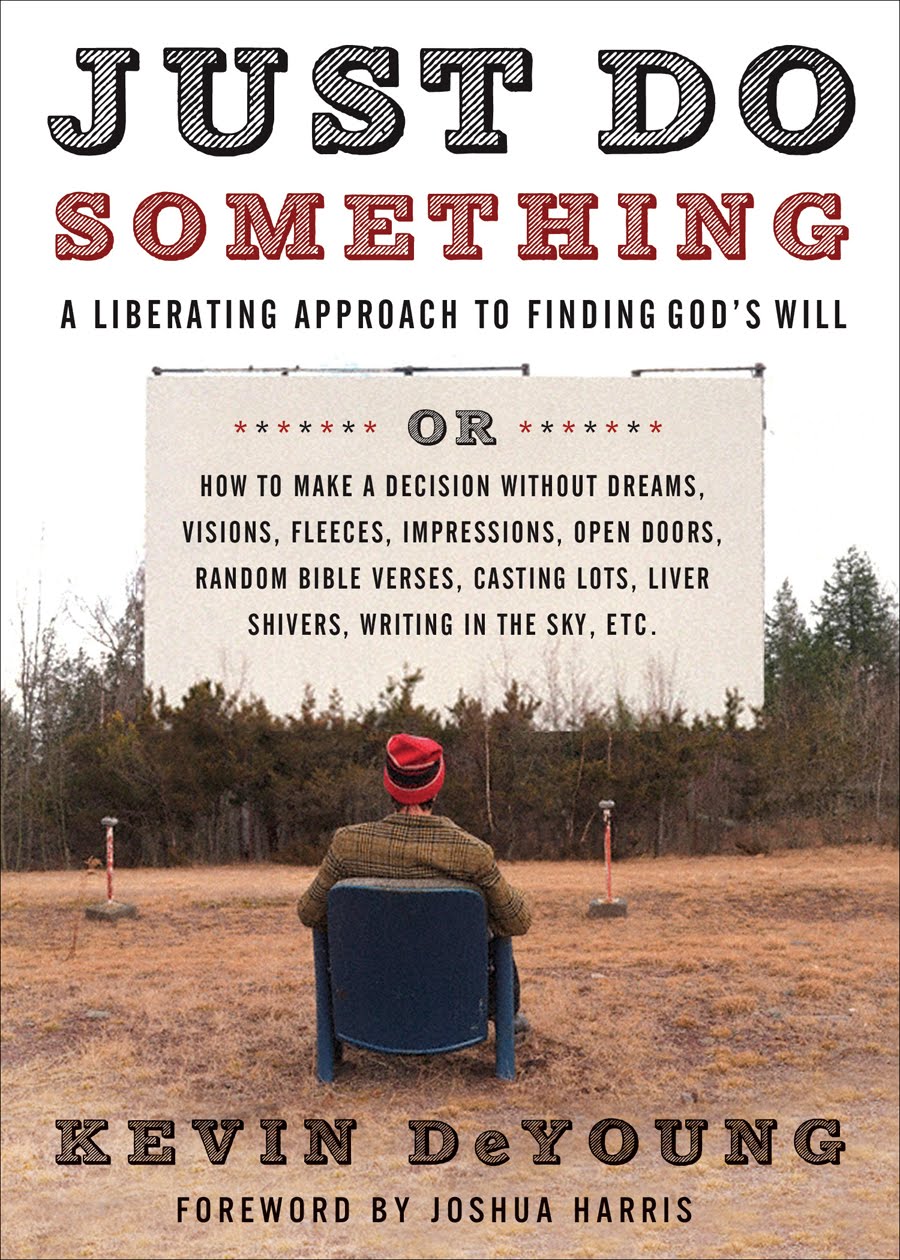
"Just Do Something" - Book Review

Recently I read Just Do Something by Kevin DeYoung. His thesis is that God's will for our lives is to be holy. His divine plan for our lives is not something we should be searching out. Rather we ought to be focused on living a Godly life, seeking first His kingdom and righteousness. This quote summarizes DeYoung's point:
God's will for your life is not very complicated. Obviously, living a Christlike life is hard work, and what following Jesus entails is not clear in every situation. But as an overarching principle, the will of God for your life is pretty straightforward: be holy like Jesus, by the power of the Spirit, for the glory of God. (61-61) 
DeYoung begins the book by looking at the amount of decision making our generation has to make and compares it with other generations. He explains how this, combined with a misconstrued understanding of God's will for our lives, creates "directionally challenged" Christians. We often sit on our hands waiting for God to show us what to do rather then go out and just doing something with our lives. He explains that God is more interested in us living holy lives rather then following his plan. Ultimately, what we do is a part of God's plan in the first place so we ought to stop worrying about it. 

Wisdom plays an important part in this. DeYoung isn't advocating running out and doing something foolish. DeYoung explains that it is by having wisdom we make decisions, both small and large. He suggests that we look to the scriptures, good friends/mentors and whether doors open as ways to deciding what to do with ourselves. 

DeYoung mentions Jerry Sittser's book, God's Will as a way of Life, which I found to be very helpful in this area. It's also along the lines of Francis Schaefer's book True Spirituality

My Thoughts 
I found DeYoung's book readable and enjoyable. It was also short. DeYoung makes a great point of explaining that the key to making good decisions in life is by having wisdom, not having the will of God. Really, it's a bit ridiculous to say that you know the will of God for future things. God hasn't revealed the immediate future to us. I found this point to be enlightening and helpful. We often find ourselves asking, "is this the will of God" when strictly speaking we cannot know. 

It may appear that DeYoung is coming across as flippant and is advocating just doing anything under the sun. He isn't, and really hammers the point across that we do need to make good decisions in our lives, but it takes wisdom to do this, not the secret knoweldge of God's will. 

It was good for me to read this book at this time in my life. I am coming to a major crossroad. Right now God is teaching me to be patient. This book was helpful because it helped quiet my worry of not knowing what God wants to do with my life. 

I encourage people my ages, college students and early 20s people to read this book. I think you will find this helpful as I did. 

Monday, October 31, 2011

"Does God Believe in Atheists" - Book Review

Pastor Ed Blackwood recently gave me a book to read called "Does God Believe in Atheists" and asked if I would review it for him. I gladly complied in spite of the size and length of the book (720 pages long).  

According to wikipedia, John Blanchard is a Canadian director. This is not the John Blanchard who wrote this book. Blanchard is a British writer and apologist. He also preaches. His focus is "popular apologetics." He has written thirty books, two of which have been well received, including "Does God Believe in Atheists." (Hereafter, "Atheists.") It has "voted 'Best Christian Book' in the 2001 UK Christian Book Awards." It seems to be very popular, at least in the UK.

Blanchard has three theses in his volume, first to trace the history of atheism in western philosophy. (Blanchard does dive a little into eastern religion but not much. This is a volume of western philosophy.) Second, he provides an account of negative apologetics. Third, he moves into positive apologetics.

I appreciated Blanchard's bullet point summary of his definition of God. This is a slippery definition, and I think Blanchard does a pretty good job, kind of.

His first thesis is interesting. We often hear about books tracing the history of God or people's belief in God but not of atheism.

Also, Blanchard's reading style is easy, fun and fairly clear.

Lastly, kudos to him for writing so many pages. It's a big book.

Minor Issues
That's all that the nice things I have to say about "Atheists." Two things need to be noted. When I began reading this I was expecting a very good book since it has received such high acclaim. Second, somewhere in the introduction Blanchard mentions this is a higher level book, for those on the collegiate level. Hence, I was expecting a good book.  My expectations were not fulfilled.I was a bit shocked by some of Blanchard's citations and lacking sources. This is the opinion of someone who just has a B.A. in philosophy and these criticism don't alter Blanchard's argument but our perspective of his argument.

I was surprised that when Blanchard quoted one of Plato's dialogues, he didn't even cite a translation but a British newspaper. Throughout the book, I noticed, Blanchard quoted from this same paper, the Daily Telegraph. Maybe it's just a British thing, but I didn't know it was okay to rely on a newspaper for your citations in an academic book.

Also, Blanchard's sources were poor. He quotes from R.C. Sproul, Gerstner, Geisler and others of the same sort. Thumbs up. Great guys to quote. No problem. I got uncomfortable when Blanchard failed to cite authority's on Aristotle, Plato, Heraclitus, Kierkegaard, Comte or Sastre. It's not that these writers are bad writers or thinkers. It's that you should be quoting much more widely then them and cite authority's of the writers your'e dealing with. For instance, if Blanchard discussed and cited what writers were saying about Plato and Atheism then it would have made for a better read. Instead, Blanchard gave just a light showing of what Plato thought and how it relates to atheism.

So far, my criticism's of Blanchard's book are a bit petty. I mean so what if his citations and sources are poor. What about his argument?

Before  I get into my criticism of Blanchard's argument, I want to note that their is a bit of wisdom we ought to think about. Luke 16:10 says "Whoever can be trusted with very little can also be trusted with much." The general idea is if you can't do well with the little stuff, how can we trust you with the big stuff?

Blanchard is not careful with these small things, so why should we trust his argument?

On to the Argument 
As I said before, their are three theses in "Atheists." I will deal with these three arguments in two parts. First, his history of atheism.

Why, as a theist, read a history of atheism? Hopefully it is to acquire a better understanding the intellectual history of that belief. In the case that I would want to have a better understanding of this narrative, wouldn't I want to read an account that is friendly to atheism? Certainly Blanchard doesn't fail to give an account, but I don't see the point of it.

My intention would be to read about the history of atheism and acquire an understanding of it. Why would I want to read a history that is going to paint atheism in a poor light? That's not going to help my understanding of atheism. Certainly, it'll influence my thoughts on not wanting to be an atheist. But I don't see the reason to read the book to learn about Blanchard's first thesis.

Blanchard's two latter theses have to do with positive and negative apologetics. Cool. I didn't notice anything unique about Blanchard's various arguments. I think if you opened up a basic intro to apologetics, you would find pretty much the same thing.

So instead of going through 700 pages to listen to these arguments, why don't you read something a bit smaller?

In conclusion, Blanchard's book had some great potential. It could have been very interesting, but because of a lack of research and not being unique in it's content, I would not suggest this book to anyone.

If you want to find out about the history of atheism  why don't you read an atheists perspective on it? If you want to learn about apologetics, why don't you read a smaller book? 

Wednesday, April 27, 2011

How to Start an Epidemic

I just finished reading Malcolm Gladwell's book "The Tipping Point." I think he should have titled it "How to Start an Epidemic" because he outlines a theory of how social epidemics are started in society, from unnatural suicide rates in Micronesia, the success of Sesame Street to the dramatic drop in crime rate in New York City and implicitly explains how you can start one.

Instead of going into an analysis of the book, I am going to suggest that two types of people read this book: pastors and teachers.

Why Teachers Should Read "The Tipping Point"

When I first started the book, I noticed that one of the rules for what causes a "tipping point" (The point at which a social epidemic occurs in society.) is "The Law of the Few." This rule essentially says that there are certain people in society that work to promote certainideas. These ideas will eventually reach the tipping point and become social epidemics.

There are three types of people: connectors, mavens and salesmen. Connectors are people who everyone seems to know them. Mavens are people who know everything there is to know about a certain topic. Salesmen are people who are really good at convincing people about an idea.

Teachers, in my opinion, should look at these types of people and see themselves to be like them, in a sense. Certainly, not everyone is a "maven." Yet because of their unique position, teachers have a great place to fulfill these important roles.

Furthermore, this book deals with the issue of why certain ideas tend to "stick" in people's heads and why others don't. That's right up the alley of education, getting ideas to stick in people's heads. If a teacher can apply the concepts in this book, I think his/her students will become better educated. Specifically, the question is "how can I communicate ideas (concepts, skills and content) to students so that they remember them?" I think Gladwell helps answer this question.

Why Pastors Should Read "The Tipping Point"

When I was reading this book, I kept thinking that the person who should read this book is a pastor. A pastor's calling is to disseminate a specific form of information to his congregation and the world. "The Tipping Point" is a book just on that topic. It explains, in a way, why revivals occur and why they don't. It explains why some people listen to you and why some people do not. It explains how society changes, improves or falters. Why wouldn't a pastor want to know more about that?

One might say, "its the Holy Spirit that works in people's hearts. It's not these foreign 'rules' put forward by Gladwell." I don't think that Gladwell is demystifying the work of the Holy Spirit. Rather, I think he is giving an explanation of a way that the Holy Spirit works through to bring about the will of the Father. Furthermore, Paul says "I have become all things to all men, that I might by all means save some." Gladwell gives pastors a means to better apply Paul's example.

A Possible Objection

One may be suspicious of Gladwell's book because it appears to give an all-encompassing explanation for everything that occurs in society. My response is first, this is not a book explaining everything about society. It is explaining why social epidemics occur. For example: why was Sesame Street such a great success for so long.

Second, Gladwell makes a great point at the end of the book. He says "All of these things [his theory] are expressions of the peculiarities of the human mind and heart, a refutation of the notion that the way we function and communicate and process information is straightforward and transparent. It is not. It is messy and opaque." (pg 257) If anything, read this book so that you acquire a more nuanced and thoughtful understanding of how communication occurs in society, even if you don't agree with the theory. It certainly has helped me think more carefully on how I see society.

p.s. It's not a hard read.

Monday, April 25, 2011

A Public Letter to Rob Bell

Dear Rob Bell,

I hope you're having a great day. I like great days. When I was a young child I used to count out how many good days I had. Today was a good day, I used part of it to read your book. I'm so sorry about it. I bet you feel awful about that terrible mistake you made. I know it is hard to admit mistakes. It happens to me all the time, but I think it's really important you tell people about this. A lot of people respect you and listen closely to what you say. I think if you announce it like you did with your latest book, that trippy video, things will be fine. I like those glasses by the way. Mine are just like them, kind of but not really. I have really bad eye sight.

In the video, start out with how your day went and how excited you were about writing out all the notes for your new book in one afternoon People would be excited to hear the story of how your book was written. You could explain how much time you spent that afternoon writing out all those notes and were exited about how big your book was going to be. Then you transition into how you decided to email your notes to someone. I don't know who you were trying to email them to. You should probably say who. Also, figure out a really neat transition, perhaps take off your glasses in one epic shot. Those are sweet glasses. Taking them off will only add attention to them. Once that's all through, tell us what really happened when you sent that email. You accidentally sent your notes to the publisher who thought it was the final book and then published it! That's why everyone is so confused and frustrated.

I realized this when I got about halfway through the book. Giving just one line to "beautiful" or "this age" didn't seem to flow well. I hope you can come clean though. With your glasses, everyone thinks you're cool, and I think people are starting to think I'm cool since I have glasses kind of like yours.

For your actual book, could you please cut out a couple of your jokes. They're not funny. Also, in the section where you allude to you going to an Eminem concert, I would take that out. People might be shocked that you went to one of his concerts. And if you want to leave in all your jokes you can. Please just be careful. Your flippancy might get you in stuck in a theological morass, but theology isn't really the issue in your book at all. Your readers might get side-tracked by your jokes, and that's terrible! I spent about 2 seconds trying to figure out the Kincaid-Dante joke. I could have gotten through a couple more lines in that amount of time. (I'm not sure if I still get it.)

Lastly, I am worried that your actual book might be too long. I think as you expand on these notes, perhaps you should leave out discussing some of these topics, narrow it a bit. I had a philosophy professor suggest to me about writing papers that it is important to "narrow, narrow, narrow your topic. After you think it is narrow enough, narrow it even more." Also, there is no such thing as a stupid question, but there are bad questions. Comb through your notes and think to yourself, "does this question progress my thesis?" I hope this was a good letter, and you enjoyed it. Good luck with your actual book. I'm looking forward to it.

Sincerely,
David Pulliam

p.s. Is it okay if I suggest to your future readers not to read your notes and go read "The Weight of Glory" instead? It's free, short and much more uplifting. I mean, all we have right now are your notes.

Monday, March 21, 2011

"Unbroken" and Reading on an IPad

I just finished reading the book called "unbroken"by Laura Hillenbrand. I enjoyed the book immensely and had an interesting experience reading it on an ipad. This blog post is also on an iPad and I have. Found very quickly that I don't like the keyless key pad. I find typing to be very hard but that may be because i have larger hands.

Unbroken in a true story about a World War II soldier who fought on a bomber in the pacific. His plane crashes, and along with three other survivors, he stays alive on a raft for many days. Eventually he is captured by the Japanese and put in an internment camp. I won't ruin the rest of the story, but it is truly an incredible about the grace of God through the worst conditions a person can live through. I recommend this book to anyone who enjoys World War II history, stories of heroism and good writing.

Some have argued that reading on an ipad is not the same as reading a book. After doing so, I agree, it is different reading a book on an iPad. Some have also said that reading on a computer screen reduces comprehension. Since iPads are computers then reading comprehension is reduced by reading on an iPad. I can't say this is precisely true in my case since it was a different experience then reading a book on a computer screen.

To me it was like reading a book. I didn't have trouble following the story or forget what I had read, at least not more then i usually do. There were two consequences that I noticed. The first is that I found it harder to listen to my pastor's sermon after read for an extended time. It could have been because i found the sermon uninteresting, and i wasn't taking notes which is what i usually do, but it felt rather strange because i was trying fairly hard to keep up, but my brain felt different. Second, I notice that it took me a little more motivation to read another book I am working through. That may be because it's a more politically heavy reading,, but again there was something odd about it. I cant put it into words, but it was like looking at regular words didn't feel as enticing and exciting. With that said, don't try editing with an iPad, it takes forever and a day!

I think there are consequences for reasding on an iPad both good and. Bad. For me personally, I will probably end up with a kindle or an iPad some dash, but ceurrnelty I'm going to stick with books arnd paper.

Friday, June 18, 2010

The Point of Tragedy


Last night, just before the Lakers won an NBA championship, give Kobe a high five and ignore Artest, I finished a tragedy. It is called "Killer Angels" by Michael Shaara. Angels was written as a historical novel about the three day battle of Gettysburg. Incredibly easy to read but very insightful about honor, death and tragedy. According to my Apple dictionary (Which is the New Oxford Dictionary), a tragedy is "a play dealing with tragic events and having an unhappy ending, esp. one concerning the downfall of the main character."

In Angels, it is a tragedy that the South failed in that last charge, losing so many men. (All of Pickett's thirteen officers were either wounded or killed.) It's a tragedy that literally, thousands of men marched to their death but what makes a tragedy is not just the fact that there is a unhappy ending. (So many men died and the battle was lost.) One gleans a gem of truth from the terrible ending. You learn about the true nature of the characters involved, a small window into who they actually are. (The men died moving forward, with bravery.)

In 2004, the Pacer's hope of an NBA championship were dashed, completely, by Ron Artest, who now has a ring. Indianapolis still does not have a NBA championship. Reggie Miller retired without a ring on his finger. A former teammate now wearing one is partially the cause. Such a tragedy that the man who ruined a city's and great player's chance of winning a NBA title.

The question now, what gem of truth will be revealed about the character of Indianapolis and Reggie Miller? How do we end this tragedy?

Tuesday, June 15, 2010

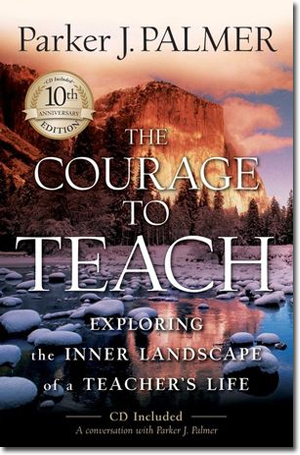
Book Review: The Courage to Teach

I apologize for not updating my blog as routinely as I should. My goal has been to update it once a week yet this summer I have not developed an efficient daily routine.

I am reviewing Parker J. Palmer's book, "The Courage to Teach." Palmer's intention is to write about the inner life of the teacher. He sticks mainly with theory, using stories to make his ideas become concrete.

Palmer's thesis is an open reaction to the direction the teaching profession has headed. Like many professions, teaching has become "disconnected," and "we are distanced by a grading system that separates teachers from students, by departments that fragment fields of knowledge, by competition that makes students and teacher alike wary of their peers, and by a bureaucracy that puts faculty and administration at odds." Palmer's thesis is that good teachers need to rid themselves of this "anatomy of fear" and become connected with their selves, have a true identity and authentic self.

He explains how this plays out in the teachers "inner life," in the teacher's relation to the student and in the community of education.

This review will be offering two positive comments and two criticisms.

Teach from your Identity
Palmer states that teachers are in a unique position because they stand in the intersection of public life and private life. Good teachers reveal part of their personal identity yet the content they teach is of the public world. In revealing their personal identity, good teachers will teach from who they are. Essentially, Palmer claims that it doesn't matter what technique you use as long as you are teaching from our personal identity. (personal identity: "an evolving nexus where all the forces that constitute my life converge in the mystery of self: my genetic makeup.")

I personally find that it's hard for me to go into a classroom and think, "Okay, I'm going to use this technique at this point and then switch over to this strategy and then use that method." I also find it hard to place myself in any pedagogical "camp." I just teach. Before reading Palmer, I was intellectually beating myself up for not being able to say, "this technique is better then that technique or this is the best method for me to use." My instincts tell me to pull as much as I can from all methods, unless a logical or practical contradiction is created. That's the type of teacher I am. I like a lot of different stuff, all stuck in there in my own pattern. This is who I am as a teacher, and when Palmer said that ultimately it is more important to teach from your personal identity then using a certain technique, I found it comforting. I don't need to place myself in a certain pedagogy camp. If I like something and it fits my need, I'll use it. If it does not, I won't use it.

"The Student from Hell"
This is from the title of a section in the book. I really appreciated this section because of two points:
1. "The way we diagnose our students' condition will determine the kind of remedy we offer."
Hence, you need to get to know your students, a really important idea for teachers to apply practically.
2. Find a voice for your students.
I find this harder then the former to put into practice because I like to talk a lot, but it ties in the previous point because in order to help the students find ways to express who they are, what they're thinking and feeling, we need to first get to know them.

Two Criticisms
My first criticism is a broad one. Palmer intentionally avoids giving "tips" or "techniques" and is solely focused on theory. I believe that an idea must have a causal impact on what we do in our lives. When teachers teach, they are doing something. I struggled to conceive of Palmer's ideas in causal way that applied to teaching. Many times he became vague, diving into philosophy, and did not show the impact of his thinking on the classroom. Hence, it seemed there were sections that I was wasting time on because I couldn't see how this applied to how I teach in the classroom. One instance is his critique of "objectivism." Not only was it vague and extremely broad, too broad in my opinion, I struggled to who he was talking about. It would have been very helpful to me if he had applied more of his theory to practice.

One could respond that he used a number of stories. This partially answers my criticism. I greatly appreciated these stories, but if only there were more!

My second criticism is a philosophical one. Palmer argues that "realty is communal." I was confused as to what he was meaning by this. Did he mean truth is discovered/known through community or truth is made through the community. The former is an epistemic statement and the latter is an ontological one. I agree with the former, but have qualms with the latter. I was confused as to what exactly Palm was saying. I would have appreciated more philosophical rigor on this section.

One may say, Dr. Palmer is an educator, not a philosopher. My response: It doesn't matter. He is speaking on very important philosophical issues that have major consequences in how we act and in society at large. In dealing with these matters, clarity is vital.

In conclusion, I enjoyed this book, it was helpful for me as an educator and has expanded my understanding of what it means to be a teacher. I certainly will remember some of the concepts explained and attempt to apply them to the classroom.

Wednesday, April 28, 2010

The Pathway Between the Seas - a review

David McCullough wrote Pathway Between the Seas (PBS) which is about the building of the Panama Canal, one of the greatest building achievements in world history.

I just finished this book on Sunday but had started in February. It is a very long book, around 600 pages, but I enjoyed it. McCullough does a great job of funneling many details and descriptions into many different themes, based on a single thread.

Why it is a such a good book
I most enjoyed the characters in PBS. McCullough does a great job of tying in many different biographies and placing them in the context of the building process. One of my favorite parts was the U.S. political battle as to where the canal was going to be built and how Panama became an independent nation.

How a 600 page book can be a quick read
PBS is a very long book filled with a lot of detailed information and it is easy to get lost in all of it. I'm not sure if this is a weakness of the book. McCullough does a great job of controlling the amount of information given to the reader, but the nature of the topic causes it to lean toward too much information. I found it best to pay attention to the main characters and do my best to remember their names. (Even if they weren't easy to remember.) Also, I tried to hold onto the main theme of each chapter, which was not too hard to do because the writer is a master at creating narratives.

Who should Read it
If you enjoy history and are comfortable weeding through a lot of details while holding on to a main theme, I would suggest that this would be a good summer read. The length of the book is challenging, but it is definitely worth reading.

What I learned
One general idea I gleaned from this book was that large movements are often controlled and determined by individual leaders. The failure of the French was caused by the naivete and ignorance of the French leaders. The success of the Americans was caused by the tenacity, organization skill and discipline of individual leaders. It surprised me that even such a large project as the Panama Canal (Its scale is massive, absolutely incredible. The locks that were built are so big that they would be part of the sky line in New York City. Only the Empire State Building and a couple other skyscrapers would be larger.) would be greatly determined by individuals. It helped me realize why one's individual actions can have momentous consequences for other people around us.

Wednesday, March 17, 2010

The Prodigal God, Book Review


Recently I finished the book "The Prodigal God" written by Tim Keller. Keller is a pastor at Redeemer in New York City. He has written one other book, "The Reason for God"It is also a very good book.

"The Prodigal God" was written by Keller after hearing his seminary professor give a sermon/lecture on the parable of the prodigal son years ago. It is a short book, and one could read it in a night or two. Keller analyzes the parable from three different perspectives. First, the lost and repentant younger son, second, the proud elder brother and lastly, the loving father. I'm not going to go into detail about the contents of the book because I don't have it in front of me right now. I will say that Keller turned my understanding of this parable upside down. He says that most people will see this as a story of a father forgiving his son for rejecting him. (I would be one of those people before reading this short book.) Keller claims there is more to what Jesus was saying then meets the eye.

Jesus was telling this parable while discussing/arguing with the pharisees about various issues. It is among a couple of other parables. The context Jesus gives this parable and his audience deepens the meaning its meaning two-fold. First, Jesus is using it to reprimand the Pharisees for being "elder brothers." They are not willing to go into their father's house to celebrate the return of their lost younger brothers. Second, look how deeply the younger brother has offended the father and the father's response to this offense.

My general feeling about the book: if you haven't read it, read it! It's short and easy. It deepend my understanding of this parable and helped me better understand myself in relation to fellow Christians. This parable has special power for evangelicals today. We are often the elder brother in this story who aren't willing to step in the house of God with those who have spit in our father's face. We won't worship with them. Why not? Keller gives a poignant and very critical answer that we need to hear.

So read it if you have not already. It's worth two-three hours of your time.

Wednesday, January 27, 2010

Shadow of the Almighty, Book review


I recently finished, just this morning in fact, "The Shadow of the Almighty," a biography of Jim Elliot, written by his wife, Elisabeth Elliot. This is one of those books that you put on your shelf, to be read again in a year.

Elliot was born in 1927 to a conservative Christian family. He died in 1956, killed by Auca Indians who he was trying to reach in order to preach the gospel to. He was a Christian.

There are very few people in Christianity who you can properly identify as simply being Christians. You associate them with a certain cause like civil rights, helping the poor, education, preaching and what not. With Jim Elliot, it can very simply be described that he was a Christian who dedicated himself to following the will of God in an absolute way.

I would describe Elliot as a fundamentalist. he did not vote, was a dedicated pacifist, he owned little and though he went to college, thought that much of what he learned was "worldly" and prohibited him from spending time with His Lord. Elliot is a prime example of what it means to not be of this world. During his early years, I think it would be an accurate describe that he was Pharisaical, meaning he lived with a lot of voluntary rules which he believed would lead him to right living and a Godly lifestyle.

When I first started to read Shadow of the Almighty, I was repelled by his attitude about Christian living. Most of my feeling stemmed from his dogmatism, he wouldn't just budge from his position on what it means to be a Christian but would go further and was less willing to adjust to his environment on secondary issues. As he grew older, as he matured in his faith, I noticed that this changed. He wasn't so blunt or obvious about his faith, it was more nuanced and fine. I also noticed that he became more respectful of people who he saw as not fully following the faith or were not Christians and not glorifying God. It was interesting to watch this transformation.

Also, even though he had a very close relationship with God, there were times of struggle. One of my favorite quotes from the book: “Sometimes one is conscious of spiritual life only because he is still struggling to maintain it, not at all because he is purposefully living it.” It is a comfort and assuring to know that life sucks for everyone, even if one is God or is very close to God.

So, for anyone who wants to read this book, it is worth your time. I was impressed by the way he honestly and fully followed Christ, dedicating himself to even death in order to fulfill his calling as a Christian.