Monday, February 18, 2013

Should Protestants Celebrate Lent?

In the spring of 2008, I visited Ireland for a semester. I worshiped church that was a part of the Church of Ireland since there were no RP churches in the town we were staying. For those who are unaware, the Church of Ireland is essentially the Anglican Church in Ireland. The service I attended was a high liturgy service. Everything was scripted except for the sermon the priest gave. This was different for me because I grew up in a church where the worship service was very simple. We sang psalms a cappella,  had an offering, listened to a sermon and prayed a lot. I found the worship services I attended in Ireland to be unique and special. There is a place in the church for having high liturgy, but that's not the point of this post.

A good friend of mine, Ethan Harrison, also went with me to Ireland. We decided to celebrate Lent since it was being emphasized by the church we were attending. I knew absolutely nothing about Lent. I think I thought it was a practice that Roman Catholics thought you had to do otherwise you'd go to hell or something though I don't think I'm sure about what I thought.

I did it because I thought it would be helpful, still do.

Since that spring, I have participated in Lent by giving up something in my life. Other students at Taylor University also followed the practice so it we were sacrificing things together. We weren't disciplining our lives alone, it was in the context of the body.

A Tension 
Since graduating from Taylor, I am still celebrating Lent. More so now then when I was at Taylor, I've noticed there is a bit of tension between my denomination and the practice of Lent. Those who went before me (The Scottish Covenanters), disagreed with the Roman Catholic Church's stance on things like Lent. They saw it as unnecessary and unhelpful. (And the Anglican Church...) They went as far as dying so they didn't have to follow traditions like Lent.

So now here is me, about 300ish years later practicing Lent in a denomination that has a history of not being a fan of Lent. (And other such practices.) I know why, but I want to think that I can celebrate Lent in good conscience.

There is a Difference
A major difference between me today and the Covenanters back then was that I'm not persecuted for my beliefs. No organization is telling me I have to celebrate Lent and is going to get an army, walk over to my apartment and make me. More importantly, I don't connect Lent with salvation, as have many. No work makes me a better person, much less makes me acceptable to God.

The Covenanters saw Lent as being connected with "works salvation." Hence, we ought not celebrate it. I agree that there is the danger of believing Lent is a work that is meritorious when the truth is that nothing makes us good except the work of Jesus Christ. It was a good thing to get rid of all the pomp and circumstance surrounding worship.

So if one sees Lent as a practice that will bring about this belief in their lives then by all means don't celebrate Lent. This is true for any practice one participates in to bring about spiritual growth. All disciplines in the Christian life must be understood as not meritorious. If a practice does bring about that belief, the individual who is in danger ought to stop.

Disciplines of the Christian Life can all be seen as Meritorious 
On the other hand, just because a practice has been seen as meritorious to some, doesn't mean it is seen as meritorious by all. In 300ish years people may become extremely critical of the discipline of Bible memorization because people began to think that the quantity of scriptures you memorized equaled to the amount of righteousness in your soul. Just because this came about, it doesn't make Bible memorization a forbidden practice. Paul says that all things are lawful for me but not all things are beneficial. (1 Corinthians 6:12) The question for all disciplines is whether they will beneficial, Lent included.

I have the freedom to celebrate Lent, and I have the freedom not to celebrate Lent. I celebrate Lent because it helps my spiritual life. Once it doesn't, I'm going to stop. Likewise, no one should celebrate Lent if it is not helpful to them.

Summary
So, should protestants celebrate Lent? That depends on whether it will help protestants or not. For some it will and others it won't. Recognize that salvation does not come from not following Lent and not from following Lent. Salvation is found only in Christ, Lent has nothing to do with it. This is true for all discipling the Christian takes part in. 

Saturday, February 16, 2013

How Many Things can Change in a Year?

I have gone through a lot of changes in the past year. Part of the transition from a college student to a young professional is that changes don't come cycles. They occur randomly, quickly and sometimes you don't even notice them.

With working so much now, I haven't had time to reflect on how my life has changed. Here is a summary of the changes:

Philosophy
1. Thomas Aquinas "solves" the mind-body problem.
-Okay, not really but what I'm reading right now is doing a lot of good for me in thinking through this problem.
2. It's hard being a philosopher around people who don't know much about philosophy.
-Sometimes you say things that are taken as "you're using reason vs. the Bible so you're a bad person." Though is probably a poor generalization.
3. Education has no good philosophical foundation outside of pragmatism.
-Western education was based on Christianity supplement by Plato and Aristotle. Since that foundation was removed in the early 20th century, pragmatism is the foundation. I really don't like pragmatism because it doesn't answer some very important questions confronting educators today.

Education 
1. It's really hard to be a teacher.
-I mean really hard, and I'm at a good school that supports my work.
2. I don't know history like I thought I did.
-I stink at pronouncing names of dead people.
3. Educators who use data and measurable outcomes are awesome.
-Because they change the lives of students for the better.

Politics 
1. President Obama was elected again.
2. The Republican Party is now crippled like the Democrats were after the Civil War. (though, I think I'm wrong on this point.)
3. I continue to dislike the Tea Party. (not much of a change...)

Triathlons 
1. I qualified for the 2013 Olympic Distance Triathlon National Championship in August.
-Pretty exited.
2. I got a friend to do a triathlon.
3. I am having knee problems. My knee won't stop hurting!

Life 
1. I moved out of my parents place and into my own place.
2. I am living without the internet. (Hence, I'm at a coffee shop right now.)
3. I am starting to like Shakespeare.
4. Last semester I lead two Bible studies, was the assistant XC coach at school, was in a book club and was discipling a young man.
-So I got really tired.
5. I got really tired.

Theology 
1. Reading Thomas Aquinas is awesome.
2. Reading 10 chapters of the Bible every day is very awesome.
3. I really look forward to Sundays. (Not just because I don't have school.) 

Monday, February 20, 2012

What is Doping?


This is the first post on a series on doping and cycling. I'm hoping to explain doping and cycling in a way that non-cyclists and non-scientists can understand.

So, what is doping? The short common answer is that it is the use of performance-enhancing drugs to make you a better athlete. This definition is quite broad. It could include caffeine and recovery drinks. Under this definition, better equipment could be considered doping if you dop the "drug" part. Obviously using caffeine or using a really nice bike is not doping. So this is a BAD definition of doping. We need something more specific.

Enter the WADA
The organization that organizes the rules for what is considered doping and not doping is the WADA. (World Anti-Doping Agency) They are the governing body for cycling. If a cyclist gets in trouble for doping, it's because of the rules set up by the WADA. In 2003, the WADA published a set of rules and regulations on doping to govern the world of sports, including cycling. They have really long lists for what is completely prohibited, prohibited in competition and prohibited in particular sports.

Doping, according to the WADA, is "the occurrence of one or more of the anti-doping rule violations set forth." So if you break one of the rules set up by the WADA, then you are doping.

That's Dumb, Why? 
The natural question to ask would be, why have these rules? Who cares if someone uses this method or that drug to help them bike faster? The answer is that it can kill you so this makes it unfair to other opponents. The reason being, if you dope and are able to get an extra edge then in order to keep up with you, your opponents also have to start doping. This wouldn't be a problem if it didn't mean that in order to compete then athletes would be putting their lives at stake. We don't want to do that. Making a sport unnecessarily dangerous is wrong. Rules should create limits that keep athletes away from unnecessary risks, doping being one of them.

In sum, doping is simply breaking the rules set up by the WADA.

Wednesday, February 15, 2012

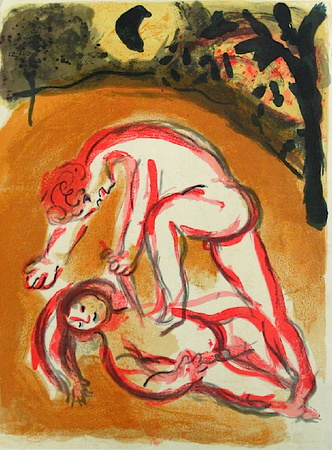
Young Men are like Cain

In Genesis 4, the story of Cain and Abel is recounted. The two brothers offered up sacrifices to God. God accepted Abel's but rejects Cain's. Cain became angry that God didn't accept his and jealous that Abel's was accepted. God warned Cain, "If you do well, will you not be accepted? And if you do not do well, sin is crouching at the door. Its desire is for you, but you must rule over it.” (ESV)

Cain was in a tight spot. He failed to please God and was angry that he didn't. Specifically he was angry that his brother did well. As a result, Cain murdered his brother.

Many young men are in Cain's position. We are just starting out in life, taking the first steps outside of college and working on our own. A bunch of us have offered poor offerings to God while in college. We've given him our video games, sports, movies, foolish relationships and worst of all sin as ways of glorifying Him. God has no regard for these things.

Now, we're at point where we can get mad at God for not accepting our works. As a result we can reject the church, shirk our holy responsibilities and walk deeper into sin. The deeper a young man walks in sin, the closer he gets to murdering his fellow brothers and sisters in Christ. In the least, he greatly hurts them.

God warned Cain that sin was crouching at his door. Likewise, sin is crouching at our door. Our lives are unacceptable to God. Sin wants us to take its path.

The question before young men today is whether we will rule over sin or will we be like Cain?

Tuesday, February 14, 2012

Lance Armstrong and Doping

You may have noticed that Lance Armstrong has entered BACK into triathlon. He recently placed 2nd at 70.3 IRONMAN Panama. He is also going to be racing in some other 70.3 Ironmans through the year. The guy can't stay away from competition.

More importantly you may have noticed at the federal government ended its investigation on Armstrong's cycling team that won seven Tour De Frances in seven years.. The decision came as a surprise to many in the cycling community. It was also conveniently announced the Friday before the Super Bowl. 

Armstrong himself was relived that the investigation is over. The investigation was made up of the Food and Drug Administration, the FBI and the U.S. Postal Service. There was talk that it was possible Armstrong was going to be charged at some point with mail fraud, drug distribution, money laundering and/or witness tampering. 

Note, it is not illegal to dope in the United States. It is illegal to do the things stated above and often cyclists will do the above in order to hide their illegal activities. (It is breaking WADA rules to dope.) 

Now the WADA is asking the federal government to turn over their findings so the U.S. anti-doping agency to continue it's own investigation. 

Many things about cycling are confusing. Doping is one of those confusing parts. It's very sad with what has happened to cycling in the last five years with now two Tour De France winners stripped of the yellow jersey. It's important to see why doping is so rampant in cycling as opposed to say basketball or hockey. 

Over the next week or so, I'll be writing a series of posts that will help explain this sad and painful part of cycling. 


Monday, February 13, 2012

What Do You Do When You Are Sick

This past week I have been deathly ill with a cold. I have been drinking lots of water and tea. Also, I have been reading and watching movies. I finished "The Adventures of Sherlock Holmes" and "Same Kind of Different Me." Both are worth reading. I also watched many movies and tv shows. Below are some reviews.

Drive
Ryan Gosling plays the part of a stunt performer who transports bad guys for five minutes at a time. A friend of my mine described this movie being just like "Rebel Without a Cause" except more depressing. I agree. It's an interesting movie if you like movies where the main actor never talks, stares a lot and beats people up really bad. Did I mention he's also a great driver?

The Guard 
I picked this movie because it was shot in Ireland, one of my favorite countries. The movie is based in Country Galway, where I spent a couple of days. It was fun seeing shots of places I've been. For those who haven't been to Ireland, you will find this movie worthwhile. Brendan Gleason does a great job acting so smart you can't decide if he's dumb or intelligent. Also, Gleason was a teacher before he became an actor so that's another reason to watch it, though not a good one.

Five Minutes of Heaven
I should have just watched just movies about Ireland during my sickness. This is a fabulous movie. The story is about how a Catholic and Protestant reconcile over a murder during the Troubles. It is a bit slow at parts and confusing if you're not familiar with the conflict in Northern Ireland. James Nesbitt does an excellent job of a playing a man who carries the guilt of his brother's murder and Liam Neeson does an okay job of playing the murderer of Nesbtt's brother. I really liked how the movie ended. That sealed it for me. Also, I thought he was going to kill him.

Sherlock Holmes (BBC TV Show) 
I watched the first two episodes of this TV show while up at Taylor visiting a friend. I watched the last episode while being sick. As a result, I'm dying to watch the second season. It's a great show. My Mom didn't like it because of how the series "modernizes Sherlock, and I agree that he's not as good as he was in the books. Literary accuracy aside, this is a great show.

Break Bad (Season 1) 
I watched the first season of Breaking Bad because my brother suggested it. I found the show to be entertaining though a bit much at points. It's a bit too slow for my liking. Also, Iwas more interested in how they made meth rather then the plot. Not that I'm going into business or anything, but honestly the chemistry was more interesting.

Those are some of the movies and TV shows I watched during my sickness. Now that I'm almost better, I am now returning back to normal and so won't be watching anything any time soon.

Monday, February 6, 2012

Criticisms of "Is Philosophy UnBiblical?"

In this post I will give three criticisms of my argument that philosophy is not unBiblical. 

First, isn't this a debate over terms and nothing more? What if you defined philosophy as "a system of thought or involving such inquiry" (David Hume's definition)? Under this definition there seems to be a contradiction between "philosophy" which is promotes specific systems of thought and/or inquiry into these systems.

It must be clarified that this argument is making two points, first it says you're arguing about simple definitions, so what! Second, you can define philosophy in a way that makes philosophy unBiblical.

My response to the first part is that definitions are important. Words have meaning. If you improperly define those meanings then you're going to run into trouble. For instance, let's talk about the definition of faith. If you improperly define faith then you might accidentally be setting up a definition that goes against scripture. You want to avoid doing that so it is important to define your terms.

My response to the second part is that by agreeing with this objection I don't have to change my argument. Under this definition, Christianity itself is included under philosophy since it promotes a certain system of thought or worldview. So even under this definition we can't get away from doing philosophy.

A second objection is that there are Christians who stayed away from philosophy like...Okay I can't think of anyone right now.

My response is that if there are such major theologians who have been able to pull off a feat, I'd love to talk to them. Yet, even if their are theologians who've completely removed themselves from "philosophy" it doesn't mean you can just stop studying thinkers like Augustine, Edwards or Thomas.

Lastly, how do we know that your ESV Bible note is right?

My response, that's a philosophical question. Specifically, it is an epistemic question.

Bottom line: by involving yourself in the debate as to whether philosophy is a Biblical enterprise, you have automatically involved yourself in the enterprise of philosophy!