Friday, August 6, 2010

Movie Review, Inception (Spoiler Alert!)


Christopher Nolan introduces another mind-altering yet action-filled movie. I was pleasantly surprised by the philosophical depth to the movie though I was disappointed with the lack of plot and character development.

Two Criticisms
First there were many parts of the plot that were rather thin. For instance, the reason the team was attempting to plant an idea into the subject's mind was to destroy a highly competitive company. Okay, what type of company were they attempting to break up, could we get a couple more details besides the fact that it was a really good company? Second, Leonardo DiCaprio's character was well developed, and he did a great job yet this was especially noticeably when the other characters lacked development. Ellen Page's character, Ariadne, was especially noticeable. She was a student of Cobb's father in Paris. She's really smart, is wise but we don't know much else.

The Philosophy of Inception
That being said, let's go on to the more interesting parts of the film. I was left pondering a very important concept. It is an epistemic issue dealing with metaphysics. The movie argued that there is an ultimate reality. (metaphysical belief) The problem that it presented was how do we know if we are in reality. (epistemic issue) The characters used "tokens" as reference points to tell them when they were in reality or not. The key: reference points. This made me think of the famous statement by the French Existentialist Jean-Paul Satre “No finite point has meaning without an infinite reference point."

I don't want to pull any theistic interpreation into Inception because I can't find any evidence that Nolan intended to argue that because there is ultimate reality God must exist, but what I found interesting was: 1. There is an ultimate reality (there is "absolute" truth, truth that is the same no matter which way you look at it and you can't change it.). 2. We are cognitively capable of knowing ultimate reality. In Inception, knowledge came through the tokens, (reference points) which would communicate to the knower (a finite point) whether he was in a dream or reality.

Personal Note
I also enjoyed Nolan's point on letting go and coming to the conclusion that our dreams are not as good as reality. This is found in only one scene of the movie, but it is the climax and focal point of Codd's development. Here, he acknowledges that his wife has died and is ready to move on. Furthermore, he realizes that continuing to imagine her existence is not as good as who she really was. You can dream of someone but it is not as good as actually being with them. Essentially, reality trumps dreams.

Finally, the last scene of the movie shows Cobb seeing his children again. Just before he does, he checks his token (a spinning top that never stops spinning unless it is in reality.) but before the top stops spinning, he sees the faces of his children and runs to them with joy. The camera focuses on the spinning top and the curtain closes before the viewer can tell if its going to stop or not. Great ending: when you are in reality and in relationship with others, your reference point is no longer a material thing (a finite object) but other people.

Sunday, August 1, 2010

Psalm 15, Calvin's Thought

In a week from today, I will be giving the Psalm explanation at church over Psalm 15. I have been reading through Calvin's commentary on the Psalm. In verses 1 and 2, David says "LORD, who may dwell in your sanctuary? Who may live on your holy hill? He whose walk is blameless and who does what is righteous, who speaks the truth from his heart" Calvin makes an interesting point on the last phrase of this verse "who speaks the truth from his heart."

David doesn't say "who speaks the truth in his heart" rather David expresses the harmony between our speech and heart, that the two are intricately connected. As tree branches stem from the roots so do our speech stem from our hearts. Furthermore, the one who may live on God's holy hill is the one who speaks the truth from "the hidden affection or feeling within." God's people don't utter the truth. It flows from their hearts as a natural fruit.

Thursday, July 15, 2010

Poop on Shoe

I took the dogs out this afternoon so that they could do their duty. While they were trotting around in the muggy weather, I noticed a leaf on the patio. This leaf had imprinted on it a small piece of dog feeces. On the pancake shape smelly stuff there was an word pressed in by someone's shoe.

My immediate thought was "poor guy who got poop on his shoe." As I looked closer I noticed that the poop word actually spelled "Chaco" on it and in a moment I realized a shoe had not stepped on this piece of poop but a sandal. I know only one person with Chacos who regularly walks through the yard and on the patio. "Oh well," I thought, "it is not the last or the first time my room has smelled like poop." My pity turned to indifference, and I called the dogs back into the house. I'm working my school again, work before smells I always say. Maybe I should check my sandels...

Friday, July 9, 2010

Irrational Protest


In Oakland, Cal. riots occurred because of a jury's decision to not convict an officer of murder for killing an unarmed African American. The officer claimed that he accidentally pulled his gun instead of his taser, shooting the man. The jury convicted him of involuntary manslaughter. (Basically saying that his "mistake" was so bad that it counts as a crime.)

In response, many rioted in Oakland, breaking the law themselves, as a protest to the jury's decision. I find this irrational on a couple of levels.

First, a jury, a group of citizens and the rioters equals, gave the sentence. There were groups who peacefully protested this decision yet I'm not sure why they would want to protest what a jury decided because that jury, I assume, was made up of people of them.

Second, those who rioted acted in the name of the victim. They broke the law as a way of protesting against one who they believe broke the law. If they are in favor of the law being handed out, why go break what you're trying to uphold?

Lastly, what good is going to come of this? I don't know many riots that have resulted in better governments, better societies or a happy people. I know approximately 50 people were arrested. They're probably not very happy.

Though it may appear from our view that the officer should be convicted of murder, we need to be careful to weigh our opinions carefully. A carefully weighed opinion means you spend careful time looking at the matter (perhaps six hours like the jury did), and when you come to a conclusion, don't act in a way that warrants arrest. (Like that officer.)

Wednesday, July 7, 2010

"How was ECHO?

"ECHO was great," has been my general response to that question. The work was hard and co-leading 16 students for two weeks was no easy task, especially if they enjoy arguing. ( I mentioned it a couple times, and they tried to argue about it...) I learned a lot about leadership, agriculture and myself.

I also learned that it is important to not get eight blisters on the first day of work.

Helping lead 16 students for two weeks was different from any other ministry work that I've done. I did have two week kampers as a Kamp Counselor, but working for two weeks with students was different. At Kamp, we had a good time. At ECHO, we didn't always have a good time. I learned a lot about leading a group when you're under a lot of pressure. By far it was fun group to be with. I enjoyed hanging out with everyone, even if I did get kicked in the face with a soccer ball when I sleeping. I'm surprised no one pulled the plug on my air mattress on the last night. I noticed at the end of the trip that relationships (good relationships!) had started between people in the groups. You know that a friendship is formed when you stay in contact with each other over long distances. I sensed that with this group. I'm looking forward to seeing a bunch of them at Covfamikoi and then at the International Conference. (I also see a couple of them at church each week.)

This was my third time at ECHO. One way I changed from my last two trips was that I paid closer attention to what ECHO is doing. I also paid attention to names of plants and how agriculture works. I loved planting Lablab seeds, partially because I saw them begin to sprout while I was there. (I have pictures!) I now have a vendetta against bamboo even though everyone seems to like it. I don't, 50 lb. tubs full of bamboo is not fun to carry. It's heavy and more scratchy then corn leaves!

Whenever we're put under stressful situations, we learn a little bit more about ourselves. Near the end of the trip I started to notice that I didn't work as hard when I was alone or without someone "important." (One of the ECHO stafff, an intern or Mr. Hanson and Mr. Stuart.) I am a performance driven person, the more people who are watching me, the better I usually perform. I started to apply a part of theology that I'm reading in Aquinas right now: that God is everywhere and in everything. Because he is everywhere, he can see all that I do. It is deceptive for me to believe that I am ever truly alone.

Now you know a little bit about my trip to ECHO. I'm glad I went, it was a great experience, the students were a lot of fun and it was great to work with Mr. Hanson and Mr. Stuart.

Friday, June 18, 2010

The Point of Tragedy


Last night, just before the Lakers won an NBA championship, give Kobe a high five and ignore Artest, I finished a tragedy. It is called "Killer Angels" by Michael Shaara. Angels was written as a historical novel about the three day battle of Gettysburg. Incredibly easy to read but very insightful about honor, death and tragedy. According to my Apple dictionary (Which is the New Oxford Dictionary), a tragedy is "a play dealing with tragic events and having an unhappy ending, esp. one concerning the downfall of the main character."

In Angels, it is a tragedy that the South failed in that last charge, losing so many men. (All of Pickett's thirteen officers were either wounded or killed.) It's a tragedy that literally, thousands of men marched to their death but what makes a tragedy is not just the fact that there is a unhappy ending. (So many men died and the battle was lost.) One gleans a gem of truth from the terrible ending. You learn about the true nature of the characters involved, a small window into who they actually are. (The men died moving forward, with bravery.)

In 2004, the Pacer's hope of an NBA championship were dashed, completely, by Ron Artest, who now has a ring. Indianapolis still does not have a NBA championship. Reggie Miller retired without a ring on his finger. A former teammate now wearing one is partially the cause. Such a tragedy that the man who ruined a city's and great player's chance of winning a NBA title.

The question now, what gem of truth will be revealed about the character of Indianapolis and Reggie Miller? How do we end this tragedy?

Tuesday, June 15, 2010

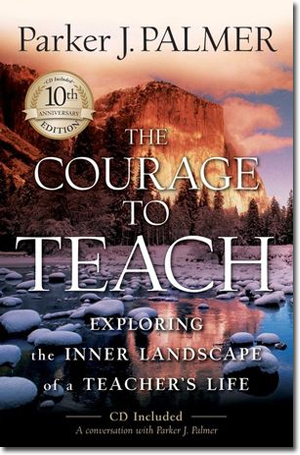
Book Review: The Courage to Teach

I apologize for not updating my blog as routinely as I should. My goal has been to update it once a week yet this summer I have not developed an efficient daily routine.

I am reviewing Parker J. Palmer's book, "The Courage to Teach." Palmer's intention is to write about the inner life of the teacher. He sticks mainly with theory, using stories to make his ideas become concrete.

Palmer's thesis is an open reaction to the direction the teaching profession has headed. Like many professions, teaching has become "disconnected," and "we are distanced by a grading system that separates teachers from students, by departments that fragment fields of knowledge, by competition that makes students and teacher alike wary of their peers, and by a bureaucracy that puts faculty and administration at odds." Palmer's thesis is that good teachers need to rid themselves of this "anatomy of fear" and become connected with their selves, have a true identity and authentic self.

He explains how this plays out in the teachers "inner life," in the teacher's relation to the student and in the community of education.

This review will be offering two positive comments and two criticisms.

Teach from your Identity
Palmer states that teachers are in a unique position because they stand in the intersection of public life and private life. Good teachers reveal part of their personal identity yet the content they teach is of the public world. In revealing their personal identity, good teachers will teach from who they are. Essentially, Palmer claims that it doesn't matter what technique you use as long as you are teaching from our personal identity. (personal identity: "an evolving nexus where all the forces that constitute my life converge in the mystery of self: my genetic makeup.")

I personally find that it's hard for me to go into a classroom and think, "Okay, I'm going to use this technique at this point and then switch over to this strategy and then use that method." I also find it hard to place myself in any pedagogical "camp." I just teach. Before reading Palmer, I was intellectually beating myself up for not being able to say, "this technique is better then that technique or this is the best method for me to use." My instincts tell me to pull as much as I can from all methods, unless a logical or practical contradiction is created. That's the type of teacher I am. I like a lot of different stuff, all stuck in there in my own pattern. This is who I am as a teacher, and when Palmer said that ultimately it is more important to teach from your personal identity then using a certain technique, I found it comforting. I don't need to place myself in a certain pedagogy camp. If I like something and it fits my need, I'll use it. If it does not, I won't use it.

"The Student from Hell"
This is from the title of a section in the book. I really appreciated this section because of two points:
1. "The way we diagnose our students' condition will determine the kind of remedy we offer."
Hence, you need to get to know your students, a really important idea for teachers to apply practically.
2. Find a voice for your students.
I find this harder then the former to put into practice because I like to talk a lot, but it ties in the previous point because in order to help the students find ways to express who they are, what they're thinking and feeling, we need to first get to know them.

Two Criticisms
My first criticism is a broad one. Palmer intentionally avoids giving "tips" or "techniques" and is solely focused on theory. I believe that an idea must have a causal impact on what we do in our lives. When teachers teach, they are doing something. I struggled to conceive of Palmer's ideas in causal way that applied to teaching. Many times he became vague, diving into philosophy, and did not show the impact of his thinking on the classroom. Hence, it seemed there were sections that I was wasting time on because I couldn't see how this applied to how I teach in the classroom. One instance is his critique of "objectivism." Not only was it vague and extremely broad, too broad in my opinion, I struggled to who he was talking about. It would have been very helpful to me if he had applied more of his theory to practice.

One could respond that he used a number of stories. This partially answers my criticism. I greatly appreciated these stories, but if only there were more!

My second criticism is a philosophical one. Palmer argues that "realty is communal." I was confused as to what he was meaning by this. Did he mean truth is discovered/known through community or truth is made through the community. The former is an epistemic statement and the latter is an ontological one. I agree with the former, but have qualms with the latter. I was confused as to what exactly Palm was saying. I would have appreciated more philosophical rigor on this section.

One may say, Dr. Palmer is an educator, not a philosopher. My response: It doesn't matter. He is speaking on very important philosophical issues that have major consequences in how we act and in society at large. In dealing with these matters, clarity is vital.

In conclusion, I enjoyed this book, it was helpful for me as an educator and has expanded my understanding of what it means to be a teacher. I certainly will remember some of the concepts explained and attempt to apply them to the classroom.